Hello everyone!😊
I have been thinking about writing this since yesterday. But you know, something or the other kept coming up, and I could only start on this article today afternoon. Wednesday woes after all!
Makes me wonder, why do we say
‘Wednesday Woes’?
Wednesday has been considered the woeful day for long.
Infact all the days of the week have a history.
All the days have been named after planets and stars and Gods.
Sunday is named on the Sun. Monday on the moon. Saturday is named on planet Saturn.
The principal god of the Norse, Viking, Germanic mythology was the one-eyed Woden, god of wisdom and divination, whose crows told him everything that happens in the world and who with his rune stones could always see the past and the future. His day, Woden’s day, is now called Wednesday.
The day before Woden’s day, Tuesday, belonged to Tiw or Tiu, the Anglo Saxon , brave God of war, who placed his arm in the mouth of a giant wolf so that he could be chained by the dwarves and thus restrained from destroying the world.
The day after Woden’s day belonged to Thor, the great hero and Lord of Thunder. Thor was Woden’s son by Friia, the love-goddess who gave her name to Friday.
Tiw was associated with the planet Mars, Woden with Mercury, Thor with Jupiter and Friia with Venus.
India had no contact with the Germanic or Viking tribes. Yet, in the Hindu calendar of India Tuesday is called Mangal-vaar or the ‘Day of Mars’, Wednesday is called Budha-vaar or the ‘Day of Mercury’, Thursday is called Brihaspati-vaar or the ‘Day of Jupiter’ and Friday is called Shukra-vaar or the ‘Day of Venus’. The practice of naming days after planets has been traced back to the Ramayana, the great epic.
Coming back to my original question, I guess ‘Wednesday woes’ arose because the day is right in the middle of the week- and you need a break from work, weekend is still away – no wonder you feel woeful.😐 (woeful- sad, sorrowful).
By the way Wednesday is pronounced as
‘wenz-day’.😊
Just as the days of the week are identified by various characteristics and origins- people
too have different characteristics and styles.🕺💃
Let’s discuss a few words associated with people and their individual styles.
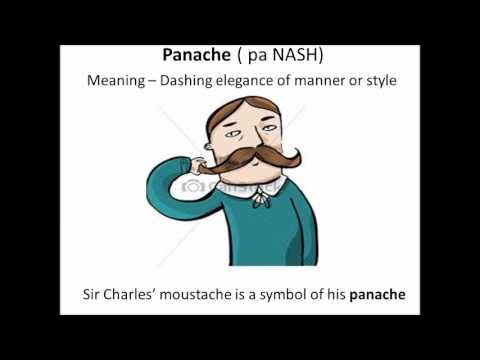
1. PANACHE
Noun
Pronounced as- “puh-nash”

# a very stylish, original and very confident way of doing things that makes people admire you.
another meaning is
# a tuft or plume of feathers, especially as a headdress or on a helmet.
Panache derives via Middle French from Late Latin pinnaculum, meaning “small wing” or “gable,” (the triangular upper part of a wall at the end of a ridged roof) – that also gave English the word pinnacle. In both French and English, panache originally referred to a showy, feathery plume on a hat or helmet; its “dashing” figurative sense developed from the verve and swagger of one bold enough to wear such an adornment in public.
Few can match the panache of French poet and soldier Cyrano de Bergerac. In his dying moments, he declared that the one thing left to him was his panache.
When the dying Cyrano turned his huge nose heavenward and spoke of his panache, his nose became the literal and figurative pinnacle of a multifaceted pun.
Usage in a sentence:
She played the role of hostess with great panache.
2. CACHET
Noun
Pronounced as – “cash-AY”
Two words come from the same root (the French cacher, meaning “to press, hide”)- cache and cachet, but they have different meanings.
Cache primarily refers to a thing that is hidden or stored somewhere, or to the place where it is hidden.
It has recently taken on another common meaning, “short-term computer memory where information is stored for easy retrieval.”
Cachet usually means “prestige” or “a characteristic feature or quality conferring prestige.”
However, cachet does have additional meanings which share little of their meaning with prestige, including a medicinal preparation for swallowing, and a seal used especially as a mark of official approval.
Usage in a sentence-
A Mercedes carries a certain cachet.
3. LISSOME
Adjective
Pronounced as- “lis-uhm”
 # attractively thin and able to move quickly and smoothly.
# bending or moving gracefully or with ease and lightness; lithe, supple, limber, agile etc.
Lissome describes people or things that are slender, flexible, light, and graceful.
Lissome (sometimes also spelt as lissom) is a gently altered form of its synonym, “lithesome.” While “lissome” tends to be the more popular choice these days, the two words have similar pasts. They both trace back to the much older “lithe” (supple or graceful), which first appeared in English during the 14th century and comes from an Old English word meaning “gentle.”
Lissome ( lissomely) can also be an adverb meaning “in a supple or nimble manner,” but this use is rare.
Usage in a sentence-
If you watch long, thin blades of grass swishing in the breeze, they look like lissome dancers with swaying arms and torsos.
4. HURRAH’S NEST
Noun
can also be spelt as ‘Hoorah’s nest’ or ‘Hooraw’s nest’.
# an untidy heap; mess
# specifically: a tangle of debris blocking a trail or stream.
# something in a state of great disorder or raucous confusion, whether it’s a bedroom in chaos or a crowd rioting in the street.
The Dictionary of American Regional English reports that this term comes from the use of hurrah to refer to an imaginary bird thought of as noisy and untidy.
Usage in a sentence-
Due to this lockdown of recent times, I am sure, many of us have kept our house spic and span; whereas the houses of a few may be resembling a Hoorah’s nest!
While it is possible to step over and through the hurrah’s nest that bestrews the apartment during the day, a nocturnal visit to the loo can be a perilous undertaking!
5. SHAMBOLIC
Adjective
Informal
Pronounced as- “sham-bawl-ik”

# obviously disorganised or confused
# chaotic, disorganised or mismanaged
Origins of this word may be linked to ‘shambles’ – which has a bloody history involving slaughterhouses, but now refers simply to a great confusion or mess.
Usage in a sentence-
John lived in a stylishly shambolic artist’s studio.
6. STREEL
Noun
Pronounced as- “Stri-il”
 Noun
Noun# an untidy, slovenly ( untidy, dirty) person
# a disreputable, untidy person
Verb
# wander aimlessly
Both the noun and the verb date to the first half of the 19th century. The verb is older, and comes from Irish straoill-, sraoill-, meaning to tear apart, trail, trudge.
Usage in a sentence-
Her daughter will not appear in the church looking like a streel.
Youngsters were streeling through the house.
Hope you all liked the words.
But before I end this post, let’s have some fun. 😉
There was a nursery rhyme in my childhood, which I guess would be considered inappropriate for many reasons today.
I am writing it here, but please understand I have no intentions of being a racist, sexist, colorist ( if there is such a word) classist etc.etc.👍🏻👍🏻👍🏻
It’s just for fun!
Monday’s Child is one of many fortune-telling songs, popular as nursery rhymes for children. It was first published in 1838. It is supposed to tell a child’s character or future from his or her day of birth and to help young children remember the seven days of the week.
Here it is-
Monday’s child is fair of face. 🌙
Tuesday’s child is full of grace. 🙏🏻
Wednesday’s child is full of woe. 😕
Thursday’s child has far to go. ✈️
Friday’s child is loving and giving. 👼
Saturday’s child works hard for a living. 👨🔧
And the child that is born on the Sabbath day,
Is bonny and blithe, and good and gay. ☀️🤴👸
(Sabbath Day- Sunday.
blithe- happy, cheerful
gay- light-hearted and carefree
Which day were you born on?
Find out and look up your fortune! 🧐
And let me know too! 😊👍🏻
Till then, Take care!
Ciao! 🙋🏻♀️
(PS- I was born on a Sunday! – but you must have guessed it already! 😊😊😊)
 devyaniweb
Absolutely classic, love it !
LikeLiked by 1 person
Thank you 😊
LikeLiked by 1 person